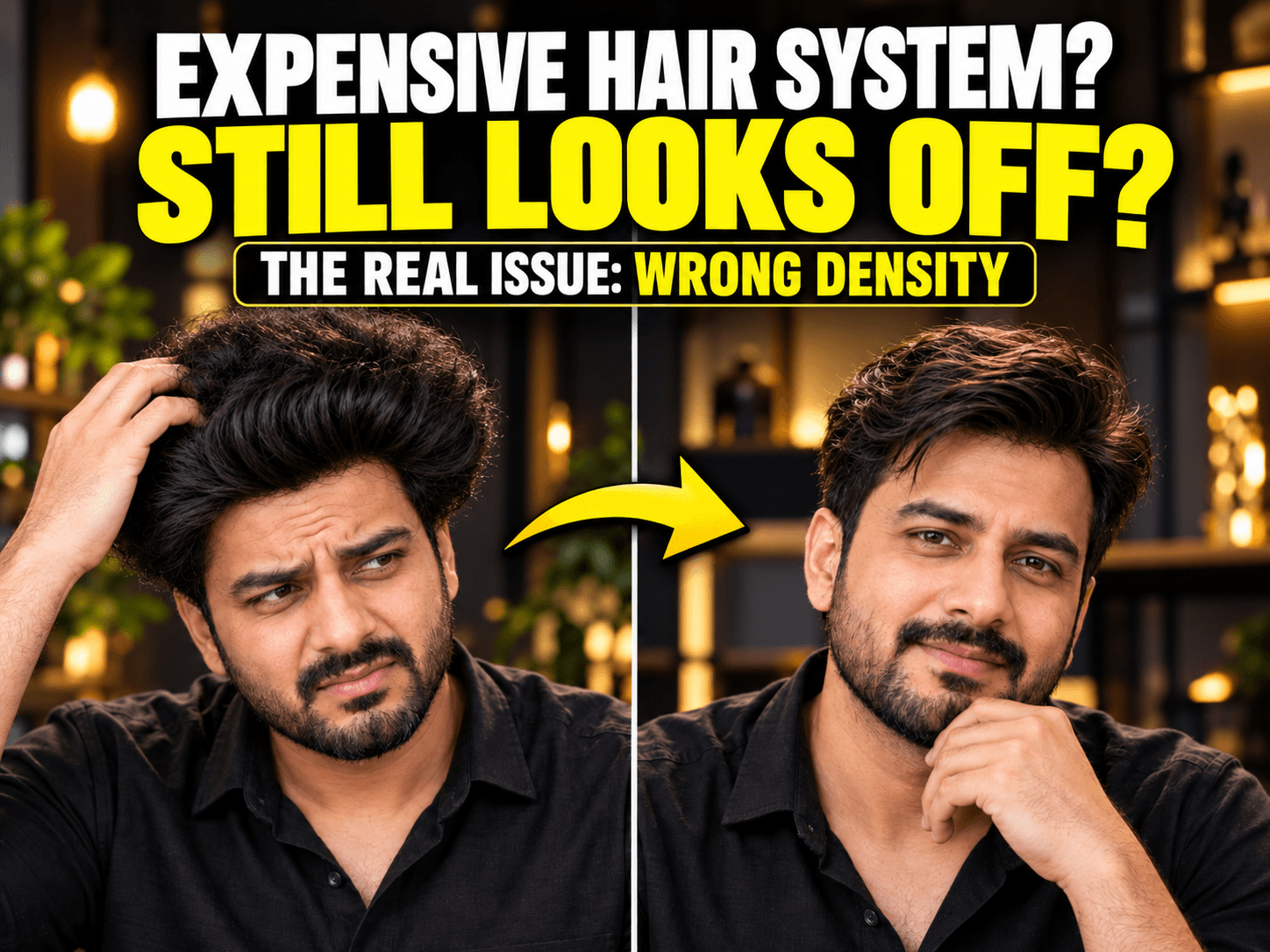
A hair system can be made with high-quality human hair, fitted with care and styled to suit your face. Yet, something about the final appearance may still feel slightly off. The hair looks fuller, the coverage is good, and the colour seems right. But when you look closely, the hairstyle doesn't blend as naturally as you expected. It might appear unusually thick around the front or noticeably heavier on top than the hair around the sides.
The first reaction is often to question the quality of the hair system. Some people assume the problem lies in the base material, while others believe a different haircut will fix the appearance. Although these factors can influence the result, they don't always explain why a seemingly well-made system looks unnatural.
One detail that frequently gets overlooked is hair density. It determines how much hair is distributed across the system and how that fullness interacts with your existing hair. When the density isn't suited to your appearance, even a carefully customized hair replacement system may struggle to achieve a balanced result.
Understanding this factor can change the way you evaluate hair systems. Instead of judging a system only by its fullness, you begin looking at whether that fullness actually belongs in the hairstyle you're trying to create.
Why Even a Good Hair System Can Look Unnatural
The appearance of a hair system depends on much more than the quality of the hair attached to it. The way the strands fall, their direction, the shape of the hairline and the relationship between the system and surrounding natural hair all contribute to the final hairstyle. Even when these details are individually well planned, they must work together to create a convincing result.
Consider the difference between looking at a hair system on its own and seeing it fitted on someone. A system displayed separately may appear attractive because the hair is thick, smooth and neatly arranged. Once fitted, however, that same fullness needs to complement the person's face, existing hair and preferred haircut.
This is where appearance can become unbalanced.
Natural hair rarely looks identical across every part of the head. The hairline generally has a different visual distribution from the central sections, while the sides and crown may vary in fullness. Hair texture and direction also influence how thick an area appears. When a replacement system creates an overly uniform surface, it can lose some of the variation people naturally associate with growing hair.
A convincing hairstyle isn't necessarily the fullest one. Someone with relatively fine hair around the sides may find that a heavily concentrated system on top creates a noticeable difference between the two areas. Another person with naturally thick surrounding hair might require greater fullness to achieve a similar visual balance.
This explains why hair replacement cannot be approached as a standard design that suits everyone. The system needs to work with the individual's existing characteristics, rather than simply provide maximum coverage.
The Overlooked Factor: Hair Density Matching
Hair density refers to the concentration of hair distributed across a hair system. It affects the amount of visible fullness, the overall shape of the hairstyle and how easily the hair can be arranged into different styles.
At first, selecting density may seem straightforward. Someone experiencing significant thinning might naturally prefer a thicker system because the main objective is to restore a fuller-looking hairstyle. But choosing the highest possible density isn't always the most suitable approach, particularly when the surrounding natural hair has a finer texture or lighter distribution.
Hair density matching is about achieving proportion, not simply adding more hair.
Imagine two men selecting a custom hair replacement system. One has naturally thick hair along the sides and back, while the other has finer hair with a softer overall appearance. They may want similar hairstyles, but giving both the same hair density could produce very different results. The first system might blend reasonably well, while the second could appear overly heavy.
The difference becomes easier to understand when you consider how hair behaves after styling. Dense hair can create greater volume and may sit differently when brushed to one side, lifted or combed backwards. A lighter distribution can create a softer appearance but may not support every hairstyle equally well.
Density can also vary across the system itself. The front section, central area and crown don't necessarily need identical concentrations of hair. A carefully planned distribution allows the hairstyle to have fullness where it's useful without making every section appear equally thick.
For non surgical hair replacement, density should therefore be considered during the design stage, alongside hair texture, colour and the preferred hairstyle. Leaving it as an afterthought can make other customisation efforts less effective.
How Incorrect Hair Density Affects Your Appearance
Incorrect density doesn't always mean that the entire hair system looks obviously unnatural. Sometimes the difference is subtle. The hair may appear attractive from the front but seem too bulky when viewed from the side. In other cases, the front hairline looks unusually strong despite the rest of the hairstyle appearing balanced.
The effect depends on whether the selected density is too high, too low or poorly distributed.
When the Hair System Is Too Dense
Excessive density can create a thick, compact appearance that doesn't correspond with the surrounding hair. This becomes particularly noticeable when the hair at the sides is finer or when the chosen hairstyle exposes the front hairline.
A heavily filled front section may also produce a sharp-looking boundary. Rather than allowing the hairline to have a softer visual transition, the hair can appear concentrated along a clearly defined edge.
There is another consideration that often gets missed: the haircut itself. A dense hair replacement system paired with closely trimmed sides may create a dramatic contrast. That contrast can be intentional in certain hairstyles, but if the goal is subtle blending, it may not produce the desired appearance.
When the Density Is Too Low
Low density isn't automatically a problem. In fact, a lighter distribution can contribute to a softer hairstyle when it suits the individual.
However, choosing insufficient density for the intended coverage or styling requirements may leave the hair looking thinner than expected. A hairstyle designed to have height or controlled volume could lack the necessary fullness. Depending on the base design and how the hair is parted, more of the underlying area may also become visible.
The important distinction is between deliberately choosing lighter density and selecting a level that doesn't support the desired hairstyle.
When the Distribution Is Too Uniform
A hair system may have an appropriate overall density while still looking less natural because the hair isn't distributed thoughtfully.
For instance, giving the front hairline the same concentrated appearance as the central section may make the transition look too strong. Similarly, a crown designed without considering the intended hair direction can make the fullness appear inconsistent once the hair is styled.
A balanced result requires attention to how different areas connect, not just the total quantity of hair.
Why Age, Hair Loss Pattern, and Existing Hair Matter
There is no single density level that looks right on every man. The same hair system can create different impressions depending on the person's age, facial features, hair-loss pattern and remaining natural hair. These individual differences explain why customisation is such an important part of hair replacement for men.
Age Influences Hairstyle Preferences
Age doesn't dictate how much hair someone should have. Men of the same age can naturally have different hair densities, and personal hairstyle preferences vary just as much.
Still, age can provide useful context when deciding how a hairstyle should look. Someone who prefers a mature, understated appearance may feel more comfortable with a softer hairline and moderate fullness. Another person may prefer a thicker style that reflects how they have worn their hair for years.
The objective isn't to make the hair system follow an artificial age-based standard. It's to create a hairstyle that feels appropriate for the individual, rather than choosing excessive fullness simply because it is available.
Remaining Hair Provides an Important Reference
The hair along the sides and back offers valuable information when selecting system density.
If the remaining hair is thick and coarse, a very light system may not blend well with it. On the other hand, a heavily filled system can appear disconnected from naturally fine surrounding hair. Even excellent colour matching cannot always compensate for such a difference.
Texture adds another dimension. Fine strands and coarse strands can create different impressions of fullness even when the amount of hair is similar. This means density should be evaluated visually alongside the characteristics of the existing hair, rather than treated as an isolated specification.
Hair-Loss Patterns Change Coverage Requirements
A person experiencing thinning around the crown may have different requirements from someone with extensive hair loss across the top.
Where a system covers a smaller area, the transition into natural hair can become particularly important. A broader coverage area may allow more flexibility in planning density across different sections, but it still needs to connect convincingly with the surrounding hairstyle.
The right approach depends on the coverage area, the condition of the remaining hair and the look the individual wants to achieve. These factors should guide density selection before a final design is chosen.
The Role of Hairline Design and Natural Hair Blending
Hair density becomes especially noticeable around the front hairline because this area frames the face. A well-designed hairline should consider not only where the hair begins but also how it is distributed and directed.
An overly straight or heavily concentrated front can create a strong appearance that may not suit every face. Depending on the intended hairstyle, introducing a softer distribution near the leading edge can help the hairline appear more consistent with natural growth.
But hairline design alone cannot solve every density-related issue.
The hair on top must also connect with the surrounding natural hair. If the transition between the system and the sides is visually abrupt, even a carefully shaped front hairline may not be enough to create a balanced hairstyle.
This is where several customisation elements begin working together. Hair colour should complement the existing strands, while texture needs to behave in a similar way when brushed or styled. Hair direction influences whether the hairstyle falls naturally, particularly around the temples and crown. Density provides the level of fullness that brings these elements into proportion.
A system made using 100% human hair may offer familiar movement and styling flexibility, but human hair quality doesn't automatically create an accurate match. A smooth, straight system can still look different beside naturally wavy hair. Similarly, a colour that appears close under one type of lighting may reveal a difference in another setting.
For natural hair replacement, blending is therefore a complete design consideration. The individual strands matter, but the relationship between them, the haircut and the person's existing hair matters just as much.
Common Mistakes When Choosing Hair System Density
Many people approach hair system selection with a simple expectation: the more hair they receive, the fuller and better the hairstyle will look. Although fullness is often the goal, this thinking can lead to choices that don't suit the overall appearance.
One common mistake is judging density only from a reference hairstyle. Photographs can be useful for explaining the type of look someone prefers, but they don't reveal every characteristic of the person wearing that hairstyle. Their natural hair thickness, coverage pattern, hair direction and styling technique may be different from yours.
A second mistake involves overlooking the haircut that will accompany the system. Hair density needs to support the intended style. A haircut with significant height or volume may have different requirements from a flatter, textured hairstyle. Selecting density without considering the final haircut can make styling more challenging.
There are also some less obvious decisions worth paying attention to:
Choosing density based only on maximum coverage: This may create unnecessary bulk in areas where softer fullness would be more suitable.
Ignoring the crown: Concentrating entirely on the front can leave the crown visually inconsistent with the rest of the hairstyle.
Overlooking fine natural hair: A noticeable difference between the sides and top can affect the overall blend.
Assuming every area needs equal fullness: Natural-looking results often depend on thoughtful distribution.
Treating density as separate from texture: Hair thickness and wave pattern can influence how dense a system appears.
Another mistake is evaluating the system only immediately after professional styling. Freshly arranged hair may have a particular shape that changes during ordinary wear. It is useful to understand how the selected density supports the hairstyle when the hair falls into its usual position.
None of these considerations means that fuller hair systems should be avoided. A dense hairstyle can be entirely appropriate when it complements the person's features and remaining hair. The mistake is choosing fullness without evaluating whether it fits the complete design.
How to Achieve a More Balanced, Natural-Looking Result
Achieving a balanced hair system begins with a clear understanding of what you want your hairstyle to look like. Some men prefer a fuller, structured appearance, while others want hair that sits softly with minimal volume. Neither preference is automatically better. What matters is selecting a density that supports the chosen style while remaining proportionate to the surrounding hair.
Before finalising a custom hair replacement system, it helps to assess the thickness and texture of the natural hair around the coverage area. This provides a practical reference for determining how much fullness is appropriate. The intended haircut should then be considered, because hair that is brushed backwards, parted or worn forwards can reveal density in different ways.
Professional fitting and customisation can bring these decisions together. Rather than focusing only on the central coverage area, the design can account for the complete hairstyle, including the front hairline, temples and crown.
The following elements deserve individual attention:
Design element | What to consider |
|---|---|
Hair density | Fullness that suits the surrounding natural hair |
Hairline design | Shape and front distribution appropriate for the face |
Hair texture | Similarity to the existing hair's natural characteristics |
Hair direction | How the hair falls and responds to the preferred style |
Colour matching | A consistent appearance between the system and natural hair |
Haircut | Blending the top with the sides and back |
A useful way to assess the result is to look at the hairstyle from different angles rather than concentrating only on the mirror-facing view. The side profile can reveal whether the top appears disproportionately full, while the crown can show how well the hair direction and distribution support the intended style.
It also helps to communicate your preferences clearly during customisation. Instead of simply requesting thick hair, explain whether you want a soft front, a defined parting, a textured hairstyle or a fuller appearance across the top. These descriptions provide more useful direction because they connect density with a particular styling goal.
Finally, remember that achieving a natural-looking hair system is not about copying someone else's hair exactly. Your facial proportions, remaining hair and hairstyle preferences are individual. A design that considers those characteristics is more likely to produce an appearance that feels balanced and suitable for you.
Conclusion
A good hair replacement system involves more than selecting quality hair and achieving sufficient coverage. Hair density has a major influence on whether the hairstyle looks balanced, particularly where the system connects with existing natural hair.
Excessive density can create unwanted bulk, while insufficient or unevenly distributed hair may affect the intended hairstyle. The most suitable choice depends on the individual's features, hair-loss pattern, surrounding hair and styling preferences.
The real goal isn't maximum fullness. It's the right fullness in the right areas, supported by thoughtful hairline design, appropriate texture and careful blending.
Call us 📞+91 9222666111 today for personalized guidance on hair loss solutions! 📍 Book your consultation now at www.americanhairline.com and start your journey with Non Surgical Hair Replacement today. 👉 [Fill out this form for personalized advice.]
Ready to regain your confidence?
American Hairline provides premium, non-surgical hair replacement systems designed specifically for you. Don't wait to change how you feel.
0 Comments
No comments yet. Be the first to share your thoughts!
Leave a Reply
Your email address will not be published. Required fields are marked *